Open Monitoring Meditation Calms Physical Anxiety Symptoms
Your body knows something is wrong before your mind catches up. Maybe it’s that tightness in your chest during meetings. The way your shoulders creep toward your ears when you’re scrolling through emails. That persistent knot in your stomach that shows up uninvited and refuses to leave.
Physical anxiety symptoms are exhausting. And if you’ve tried deep breathing or basic relaxation techniques without much luck, there might be a reason-your nervous system has learned to stay on high alert,. It needs a different approach to finally stand down.
That’s where open monitoring meditation comes in.
What Makes Open Monitoring Different
Most meditation techniques ask you to focus on something specific. Your breath - a mantra. A candle flame. But open monitoring flips that script entirely.
Instead of narrowing your attention, you widen it. You become aware of everything happening in your experience-thoughts passing through, sounds around you, sensations in your body-without grabbing onto any of it. You’re not trying to relax. You’re not trying to feel better. You’re just - noticing.
Sounds almost too simple, right?
but. Research from the National Institutes of Health found something surprising about this practice. While focused attention meditation activates your parasympathetic nervous system (the “rest and digest” mode), [open monitoring meditation actually increases physiological arousal while simultaneously reducing cortisol levels](https://pmc. ncbi - nlm. nih - gov/articles/PMC8320390/). Your body becomes more alert but less stressed.
For someone dealing with hypervigilance and physical anxiety symptoms, that distinction matters enormously.
Why Your Body Gets Stuck in Alarm Mode
Anxiety is more than in your head. It’s a full-body experience.
When your nervous system perceives a threat-real or imagined-it kicks off the stress response. Heart rate jumps - muscles tense. Digestion slows down - blood pressure rises. Your body prepares to fight or run.
The problem? Modern stressors rarely require fighting or running. That email from your boss isn’t a bear. The traffic jam isn’t a predator. But your nervous system can’t tell the difference. It responds to psychological stress the same way it would respond to physical danger.
Over time, repeated stress activations can cause your body to get stuck in what researchers call a state of hypervigilance or hyperarousal. Your baseline shifts. Even when nothing threatening is happening, your system stays wound up, scanning for danger, ready to react.
This shows up as:
- Muscle tension that won’t release
- Shallow, rapid breathing
- Racing heart or palpitations
- Digestive issues
- Trouble sleeping
- Startling easily
- Feeling constantly on edge
Sound familiar?
How Open Monitoring Retrains Your Nervous System
The brilliance of open monitoring is that it doesn’t try to force relaxation. Anyone who’s told themselves to “just relax” while anxious knows how well that works. (Spoiler: it doesn’t.
Instead, open monitoring teaches your nervous system something new: awareness without reaction.
When you practice observing your experience without judging it or trying to change it, you’re essentially telling your alarm system, “I see you. You don’t need to escalate - we’re okay.
[Studies on attention regulation and meditation](https://pmc. ncbi - nlm. nih. gov/articles/PMC2693206/) show that open monitoring practices activate areas of the prefrontal cortex involved in emotional regulation. This region can essentially hit the brakes on the amygdala-the brain’s alarm center-disrupting automatic fear responses and reducing their intensity.
But here’s what I find most interesting. Unlike techniques that try to calm the body directly, open monitoring works by changing your relationship to physical sensations. You stop fighting the tension. You stop resenting the racing heart. Users observe it. And paradoxically, that observation allows things to shift.
A Simple Open Monitoring Practice for Physical Anxiety
You don’t need 30 minutes or a meditation cushion. Five minutes works fine, especially when you’re starting out.
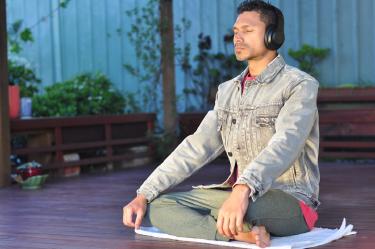
Step 1: Find your position Sit comfortably or lie down. Eyes can be open with a soft gaze or gently closed. No particular posture required-just something you can maintain without strain.
Step 2: Drop into awareness Take a couple of natural breaths. Then, instead of focusing on the breath, let your attention open up. What do you notice?
Step 3: Observe without agenda Maybe you notice sounds-traffic, a refrigerator hum, birds. Maybe you notice thoughts-plans, worries, random memories. Maybe you notice sensations-that tight spot in your neck, warmth in your hands, your heart beating.
The key: don’t try to change anything. Don’t pursue pleasant sensations or push away unpleasant ones. Just notice - name if it helps. “Tightness - " “Thinking. " “Sound.
Step 4: Stay with the flow Everything changes. Thoughts pass - sensations shift. Keep observing the natural movement of your experience. When you realize you’ve gotten lost in a thought or sensation, simply note that too. “Lost. " And return to open awareness.
Step 5: Finish gently After a few minutes, take one or two intentional breaths and open your eyes if they were closed. Notice how you feel-without judgment.
That’s it - really.
What You Might Notice (And What to Expect)
Fair warning: open monitoring doesn’t always feel peaceful, especially at first.
When you stop distracting yourself and actually pay attention to your body, you might become more aware of discomfort you’d been suppressing. This can feel counterproductive. “I thought meditation was supposed to help, not make me more aware of how tense I am!
But awareness is the first step. You can’t address what you won’t acknowledge.
Over time-usually within a few weeks of regular practice-something shifts. You start catching tension earlier, before it builds into a full-body lock. You develop a different relationship to anxious sensations. They become information rather than emergencies.
[Research on mindfulness-based approaches for anxiety](https://pmc. ncbi - nlm. nih. gov/articles/PMC4203918/) shows improvements in emotional regulation and reduced reactivity to perceived threats. Participants in these studies often report feeling less hijacked by their physical symptoms.
And the cortisol reduction? That happens at a level you won’t consciously notice. Your body just starts responding to stress differently. Less intensely - less persistently. The volume gets turned down on your alarm system.
Common Mistakes to Avoid
**Trying to make something happen. ** Open monitoring isn’t about achieving calm. The moment you try to feel different, you’ve shifted into a goal-oriented mode that works against the practice.
**Judging yourself for having thoughts - ** Thoughts are normal. The goal isn’t to empty your mind. It’s to observe your mind without getting swept away.
**Practicing only when anxious. ** This is like only exercising when you’re already out of breath. Consistency matters more than duration. Five minutes daily beats 30 minutes weekly.
**Expecting immediate results. ** Nervous system retraining takes time. Think weeks and months, not days.
When Open Monitoring Works Best
This practice tends to be particularly helpful for:
- Generalized physical tension without clear cause
- Hypervigilance and feeling constantly on guard
- Anxiety that manifests more in the body than in worried thoughts
- Difficulty with other meditation styles (especially if focus-based meditation increases your tension)
- Trauma responses where the body holds stress
It’s not a replacement for therapy or medication if you need those. But it can be a powerful complement-and for mild to moderate physical anxiety symptoms, it might be enough on its own.
The Bigger Picture
Your body isn’t broken. It’s doing exactly what it evolved to do-protecting you from threat. The problem is that the protection has outlived its usefulness. Your nervous system learned to be vigilant, and now it needs to learn that it can stand down.
Open monitoring offers a path to that learning. Not through force - not through suppression. Through the simple, radical act of paying attention without trying to change what you find.
Your chest tightens - notice it. Your heart races - notice it. Your jaw clenches - notice it.
And something strange happens. In the noticing, in the willingness to simply be with what is, the grip loosens. Not all at once - but gradually. Consistently. Until one day you realize that knot in your stomach hasn’t shown up in weeks.
Your body already knows how to settle. Open monitoring just reminds it that it’s safe enough to do so.